

Writing Without Air Cover
What happens when writing stops serving a company and starts serving the craft

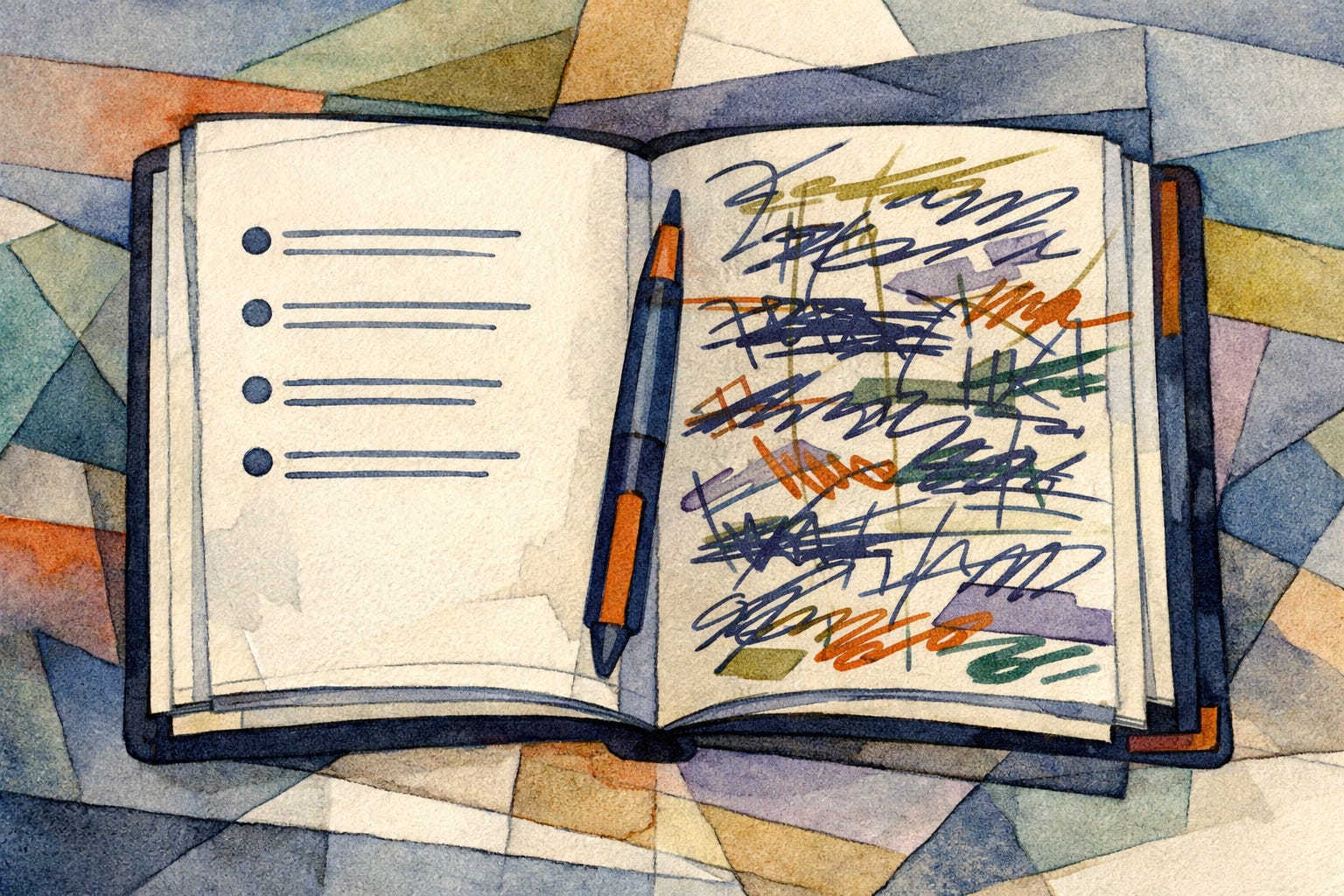
A few months ago I drafted a personal essay and wanted my sister’s opinion. Over the years we had reviewed each other’s work—product copy, memos, job descriptions—deliverables that needed to ship and be good enough.
This felt different. The piece wasn’t for a company or a launch. It was just mine, and suddenly I felt embarrassed asking her to read it.
I ended up sending an awkward message on Signal, something half‑joking about trying to write more and discovering how hard it was. She was kind enough to pick up the hint and offered to read it.
That small exchange revealed something obvious: writing with a purpose had always given me cover. Writing because I wanted to do it well did not.
DELIVERABLE, n. A written object whose primary virtue is that it exists before the meeting where someone asks if it does.
For years, most of my writing had a job to do. It helped launch products, explain decisions, or hire people. The point was never elegance. The point was movement.
If a piece of writing nudged something forward, it had done its job. No one asked whether the sentences sang; they asked whether the message landed.
That kind of writing is practical and strangely forgiving. It has structure, deadlines, and an audience that needs something from it. If the prose is a little stiff or the idea a little obvious, the work still performs its function.
The more practical it is, the more successful it becomes. Conversion rates and search rankings become the scorecard. In that environment, competence is enough.
And competence, I discovered, provides a great deal of air cover.
THOUGHT LEADERSHIP, n. The act of arranging familiar ideas into confident sentences so that they appear briefly original.
When you write for business, usefulness is the only test. The work moves something forward or it doesn’t. Clarity matters. Timing matters. But elegance is optional.
Writing for myself feels different. There is no mandate, no launch date, no search engine quietly judging the headline. The only question left is whether the writing itself holds up.
That raises the bar in uncomfortable ways. Suddenly the work depends on things that were easy to ignore before: precision, rhythm, restraint. The difference between a sentence that functions and one that works.
I read enough writing to know when it doesn’t. You can feel it immediately. The inflated insight or the clever phrasing masking a thin idea. My biggest hesitation in clicking the “Publish” button, is the fear of discovering my own work belongs in that category.
The most disarming part is the audience. There’s no Ideal Customer Profile. There are just readers. And occasionally they write back: a note about a line that landed, or a story about why a piece meant something to them. Once a comment about sharing a piece with their child. Real people, responding to something I wrote because I wanted it to be good.
Those moments feel strangely high‑stakes. A hiring post can be mediocre and still hire someone. But writing that tries to be thoughtful has nowhere to hide.
Some days I miss the safety of writing for search engines.
AIR COVER, n. The protective condition under which poor results and poorer decisions are quietly forgiven.
I’m the oldest of three. One sister studied English and was always celebrated for the quality of her writing. The other became a novelist. Writing, in a very real sense, was their thing.
I took a different path. I studied engineering and built companies. I wrote when the job required it: technical memos and strategic plans. That kind of writing had a purpose and that made persistence easy.
Even if the sentences were ordinary, the _work_ still mattered.
In hindsight, that necessity gave me a convenient excuse to keep writing. It meant I could practice the craft without really admitting that was what I was doing.
Now that excuse is gone.
When I publish something personal now, I always picture my sisters reading it. They are formidable writers and I respect their judgment. I understand how quickly a weak idea reveals itself to someone who excels in their craft.
That imagined reaction has become a private test. An imagined calibration.
I would hate the quiet eye‑roll.
PRACTICE, n. The quiet, repetitive act of doing something badly on purpose until it slowly becomes less bad.
When I sit down to write, I sometimes play a small game. I imagine how a few writers I admire might approach the same idea.
Roald Dahl would probably use simpler words than I’m using. He would strip the sentence down until only the strange image remained.
Robert Fulghum might start somewhere ordinary. A kitchen table. A small moment that quietly reveals the larger point.
Ambrose Bierce would do the opposite. He would compress the whole thought into a single sharp line and leave the reader to deal with it.
I sometimes imagine their voices hovering over the draft. Not so I can copy them — I would do a terrible job of that.
Instead, I try to picture where my own voice might land somewhere between them. Maybe simpler than I started, more concrete than I intended, or a little sharper than before. In my imagination they all disapprove of the draft so far, but imaginary respect is still something to aim for.
Bierce, especially, is hard to ignore. His definitions are so compact and unforgiving that they feel like small mechanical marvels. You wind them up and they speed off in the reader’s mind a few seconds later.
It is difficult to read them without wanting to try the same trick.
PERSEVERANCE, n. A lowly virtue whereby mediocrity achieves an inglorious success. ~Ambrose Bierce, The Devil’s Dictionary
P.S. A Note on Practice
I’m genuinely thankful for the people who read these essays, and especially for the ones who take a moment to let me know when something lands. These posts are me trying to be a little less filtered and say the quiet part out loud, so it helps to know when it resonates.
If you enjoyed this one, feel free to share it with a friend, post it somewhere online, or reply to the email and say hi. I read every note.
In The Margin
A few books that shaped how I think about writing, and one good rabbit hole on Ambrose Bierce.
Robert Fulghum - Everything I Need to Know I Learned in Kindergarten - A wonderful reminder that simple stories often carry the deepest ideas. Fulghum had a gift for starting with an ordinary moment and quietly revealing the larger truth hiding inside it.
Roald Dahl - Boy: Tales of Childhood - Dahl’s memoir of growing up. It’s a masterclass in vivid, economical storytelling. He uses very simple language to describe wildly strange and memorable experiences.
Ambrose Bierce - The Devil’s Dictionary - One of the sharpest and funniest books ever written in the English language. Bierce spent decades publishing satirical definitions of ordinary words, skewering politics, institutions, and human nature alike.
A Short Biography of Ambrose Bierce - If you’ve never heard of Bierce, his life is almost as strange as his writing. He fought in the Civil War, became one of the most feared newspaper columnists in America, and eventually disappeared in Mexico in 1913 while observing the revolution.
The Disappearance of Ambrose Bierce
What I’m Reading
Recent articles I’ve enjoyed and recommend


Independent writing is uncomfortable, but that’s probably why it produces more honest thinking
I definitely get more nervous about how the stories I write for Being Fearless, Being Me will land, vs the ones I write for Code Like a Girl.
The CLAG ones are often a bit more formal and a little less personal.
The ones for BFBM are usually deeply personal. At the same time I find it freeing.
I will always remember the day I published the story of my eating disorder on medium: https://medium.com/invisible-illness/2016-the-year-i-recovered-from-an-eating-disorder-63c66f221272
It was the last step in removing all the shame I had had around having an eating disorder. It freed me.
This story I posted in May did the same. https://dinahbeingme.substack.com/p/i-didnt-plan-to-come-off-antidepressants
My hope was also that by telling my story others could find help.
So yes I still get nervous about talking about my feeling is the real world, but I also feel they bring me freedom.
Ok i didn't realize how long this was getting. Thanks for reading :-)