

Pull On Time
How large leaps compress feedback and growth

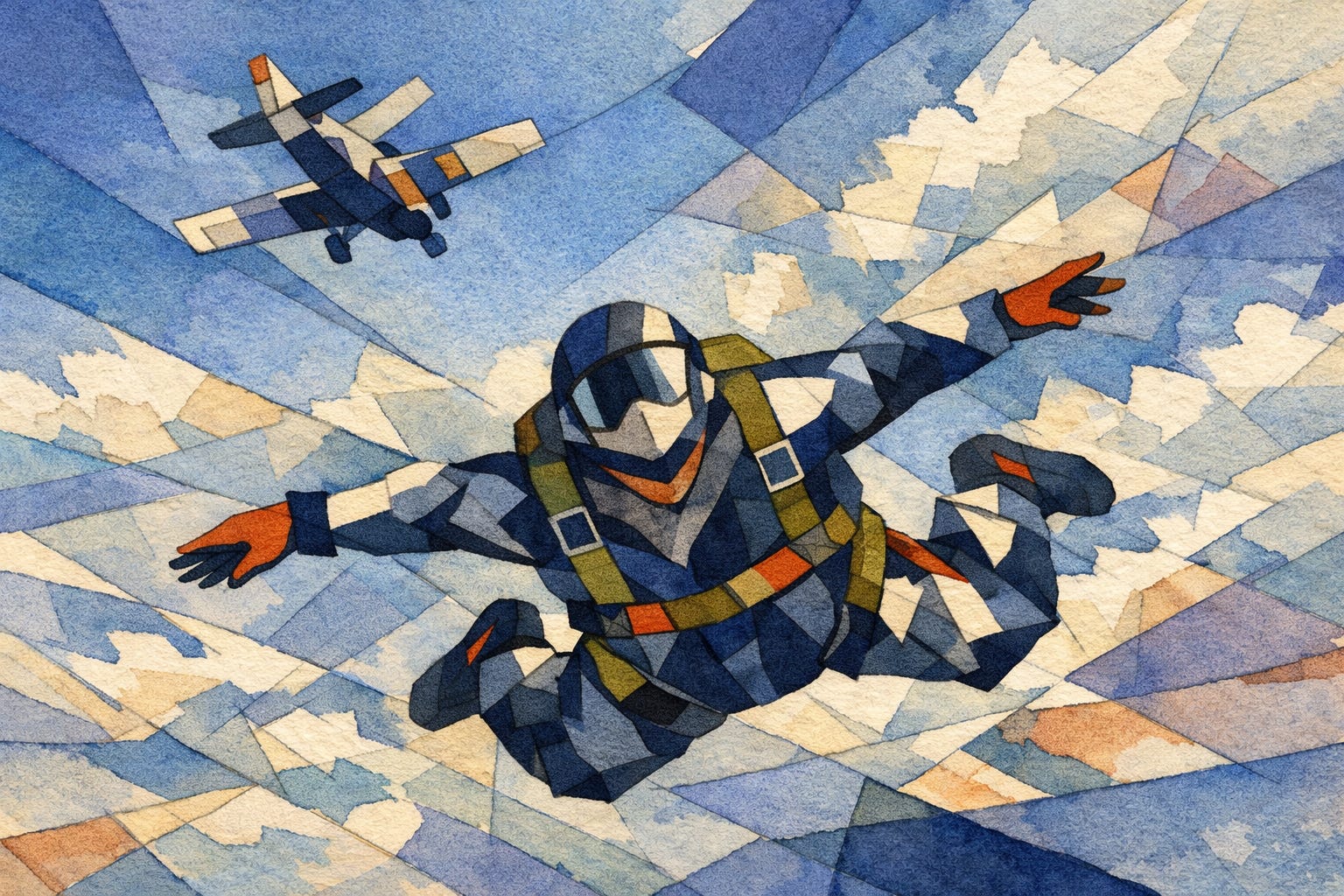
I didn’t realize it at the time, but hanging from an airplane on my 30th birthday was less about courage and more about diagnosis.
It was louder than I expected. The wind, I mean. Once the door snapped open, the air roared past the cabin and wrapped around us like something alive. When I stepped out, it caught the legs of my coveralls and snapped them tight. The fabric thrashed against my calves like I’d stepped into a river in flood.
For a second, I was certain I’d be swept away.
Which was strange, because I was there to fall.
We’d jump at 11,000 feet. At 5,000, pull. If you froze, an instructor would pull for you.
There was an eighty‑year‑old woman in our group. When someone asked why she’d chosen skydiving, she shrugged. “We’re all gonna die someway.” She said it like she was commenting on the weather.
The jump wasn’t the hardest part. That honour belongs to climbing out under the wing. The sideways shuffle along the strut, fingers gripping cold metal while the wind tried to peel me off.
My brain was loud.
This is unnecessary.
You can change your mind.
Thirty is a fine age to stay alive.
Then I let go.
The noise softened. The wind steadied. Freefall narrowed everything. Time stretched. The world simplified. Hamilton — Steeltown — looked toy-sized below, its mills reduced to geometry. Beyond it, the farm fields of Flamborough lay in patient grids. I remember thinking, with surprise, that it was peaceful.
My altimeter ticked down.
9,000.
7,000.
At 5,000, pull.
I saw the number approach. I also saw the view. Some beauty doesn’t ask permission. It takes your attention and holds it.
5,000 passed.
I reached too late; someone else pulled my chute.
I don’t remember the opening. I remember being annoyed that someone had interrupted the calm.
The parachute was clean and steady above me, like a reprimand.
It wasn’t me who had pulled it.
I’ve always been someone who jumps in.
Not to say I’m reckless, I’m just impatient with the process. If there’s a door, I’d rather open it than debate the door knocker.
Rather than choosing tandem, I chose the solo free-fall. If I was going to do it, I wanted the whole thing.
That was usually my logic.
When I decided to learn Chinese, I didn’t take evening classes. I moved to China. Immersion would sort it out.
When we were raising capital years later, we didn’t aim for the sensible round. We pushed for twice as much. We flew to San Francisco. Then Boston. If there was a ceiling, I wanted to press on it.
Back then, the leap was about outcome. If it worked, it was justified, and if it didn’t, it was a lesson in restraint.
I wasn’t paying attention to what the reach itself was teaching.
It took me a while to notice what the leap was actually giving me — it compressed feedback. It showed me quickly where I was limited and where I was stronger than I thought.
In China, the diagnosis arrived fast.
I assumed speaking to strangers would be hardest. It wasn’t. I talked to anyone. Taxi drivers. Baristas. Colleagues. I didn’t mind sounding foolish.
Writing was different. Copying characters until my fingers ached. Memorizing vocabulary without conversation attached. And tones. I couldn’t hear them cleanly. It felt less like confusion and more like missing hardware.
One night at a bar, I told a story about a goldfish and learned, quickly, that I had just made a thoughtful remark about a prostitute. Damn those tones.
Immersion exposed those limits within weeks. A classroom would have let me orbit my strengths for years.
The same thing happened in startup fundraising.
I expected to find a ceiling. We asked for twice what once felt ambitious. We flew anyway. However, the ceiling never appeared.
Instead, I learned how quickly we could sharpen a pitch after it fell flat. How much rejection we could absorb without shrinking. How modest our “ambitious” number actually was.
How leaps only guarantee clarity, not success.
It also corrected my sense of risk. The dramatic parts weren’t always the dangerous ones. Some limits were imagined. Others were structural. All of them surfaced at once.
Looking back, the jump feels less like a stunt and more like a case study.
The fear lived along the short steps along the strut. The jump was surprisingly easy. So often, anticipation spikes the body, and execution steadies it.
What I lacked was orientation. And focus.
After the chute opened, the ground looked abstract. Distance was hard to judge. The radio in my ear told me when to turn.
At thirty, I thought I had proven courage, and now I see attention.
The jump showed me how easily I can drift. How calm in one phase says nothing about competence in the next. The leap didn’t teach me bravery; it taught me that attention has to travel with you.
If you lose it mid-air, gravity doesn’t negotiate.
These days, I don’t expect clarity in the moment. Adrenaline makes that unlikely. When you compress feedback, you’re usually too busy trying not to drown to analyze the water.
So I reflect after I land. I ask what the leap exposed.
I still prefer the leap.
But I study it.
And I watch the altimeter.
In business, we talk about growth as stretching the comfort zone. Usually that means adding weight slowly. Expanding the circle by inches. Improving quarter by quarter.
There’s discipline in that, but incremental progress has a critical blind spot. It lets you stay calibrated to yesterday’s assumptions.
A large leap does something different; it collapses time.
Years of polite feedback arrive all at once, and the questions you were avoiding becomes unavoidable. And sometimes you discover you were underestimating yourself. Many ceilings turn out to be self-installed. You don’t find that out by nudging them. You find out by pressing hard enough to hear whether they’re structural.
The leap isn’t bravado. It’s a faster way to find out.
And sometimes, it’s the only way to surprise yourself.
~
I still think about that moment in the air.
Hamilton small beneath me. The mills reduced to lines. The farm fields steady and quiet beyond the escarpment.
The peace of falling.
I was annoyed when the chute opened.
Now that feels like the useful part.
The view is still beautiful.
And somewhere in the back of my mind, there’s always a number.
5,000 feet.
Enjoy the fall.
Pull on time.
A Note on Practice
I do this a lot. It’s one of my go-to moves. If there’s a ladder, I’m looking for a way to skip a few rungs. It was super hard to narrow this essay down to just these examples as there are so many more more.
Some I didn’t include because they’re still unfolding. Some because they didn’t go well. Our recent acquisition of a business much larger than ours is a good example. That leap compressed feedback fast. It also compressed sleep and ego. Not all the clarity was comfortable.
I know this approach doesn’t work for everyone. Some of the people I respect most prefer to master a skill before reaching for the next one. They build clean foundations and there’s real strength in that.
So don’t take this essay as a recommendation. It’s really just something I’ve noticed about myself. Big leaps don’t automatically create growth. They just remove illusion faster.
And for me, that’s usually worth it.
I was also thinking, while writing this, about how easy it is to confuse ambition with ego. Sometimes the leap is diagnostic. Sometimes it’s just noise. I don’t always know which is which until later. Still figuring that part out.
In the Margin
Here are a few things this piece kept brushing up against. I’m sharing in case you find them interesting as well.
Making of “The Fall of Icarus” - one of my favourite photos ever
Paper: physiological arousal ahead of action is often misinterpreted as fear
Substack: article on challenging yourself to find people who are ahead of you.
What I’m Reading
Recent articles I’ve enjoyed and recommend